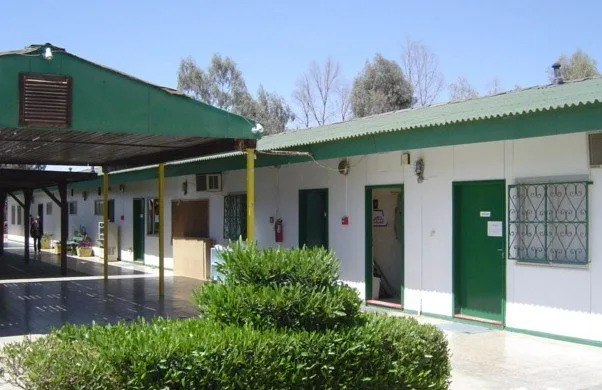
Ain Sokhna
Virtual asset linked to this landmark

- Virtual owner
- The platform
- Times sold
- 0
- Fame on Wikipedia
- 15,194 article reads in 12 months
- Searches (30 days)
- 0
- Watching
- 0
Virtual ownership only. It gives no legal, financial or physical right in the real landmark. Prices are set by the market and may fall.
About Ain Sokhna and its history
A coastal area on the Gulf of Suez south of the city of Suez, named after the hot springs found nearby.
Al-'Ain al-Sokhna (Arabic: العين السخنة, romanized: al-ʿAyn as-Sukhna Egyptian Arabic pronunciation: [elˈʕeːn esˈsoxnæ], "the Hot Spring") is a town in the Suez Governorate, lying on the western shore of the Red Sea's Gulf of Suez. It is situated 55 kilometres (34 mi) south of Suez and approximately 120 kilometres (75 mi) east of Cairo.
History
Recent archaeological excavations have shown that there was an ancient Egyptian port and settlement in this area. The site was first brought to attention in 1999 by Professor Mahmud Abd El Raziq. French and Egyptian archaeologists have been investigating this area since that time. It can be compared with the port of Mersa Gawasis further south. It connected the mining areas of the Sinai with Memphis some 120 km across the Eastern Desert, important for turquoise and copper.
As early as the Old Kingdom, seafaring expeditions on the Red Sea were organized from this port. Similar material was also found at the Wadi Maghareh, where many Old Kingdom inscriptions are found.
In the Middle Kingdom, activity continued along the Red Sea and across to the mining areas in the Sinai.
In Year 1 of Mentuhotep IV, an expedition of 3,000 men was sent to bring back "products the desert".
Some 4,000 men were sent in an expedition during the reign of Amenemhat I. In Year 9 of Senusret I and Year 2 of Amenemhat II more expeditions were sent. Ity, son of Isis, was an official serving Amenemhat II and he also has two inscriptions at Wadi Maghara dated to the same year. Ten storage galleries cut into the rock has yielded items, including wooden boat planks, ceramics from the 12th Dynasty, and a gold pendant with parallels to some found at Dahshur dating to the reign of Senusret III.
Climate
Köppen-Geiger climate classification system classifies its climate as hot desert (BWh), as the rest of Egypt.
Information source: Wikipedia · rewritten and edited by Maalem; available under CC BY-SA 4.0
- Location
- Suez, Egypt
- Coordinates
- 29.6000, 32.3167
- Category
- Beaches & Dive Sites
Source: Wikipedia · Factual information about the real landmark; unrelated to virtual ownership.