Medinet Habu
Virtual asset linked to this landmark

- Virtual owner
- The platform
- Times sold
- 0
- Fame on Wikipedia
- 46,618 article reads in 12 months
- Searches (30 days)
- 0
- Watching
- 0
Virtual ownership only. It gives no legal, financial or physical right in the real landmark. Prices are set by the market and may fall.
About Medinet Habu and its history
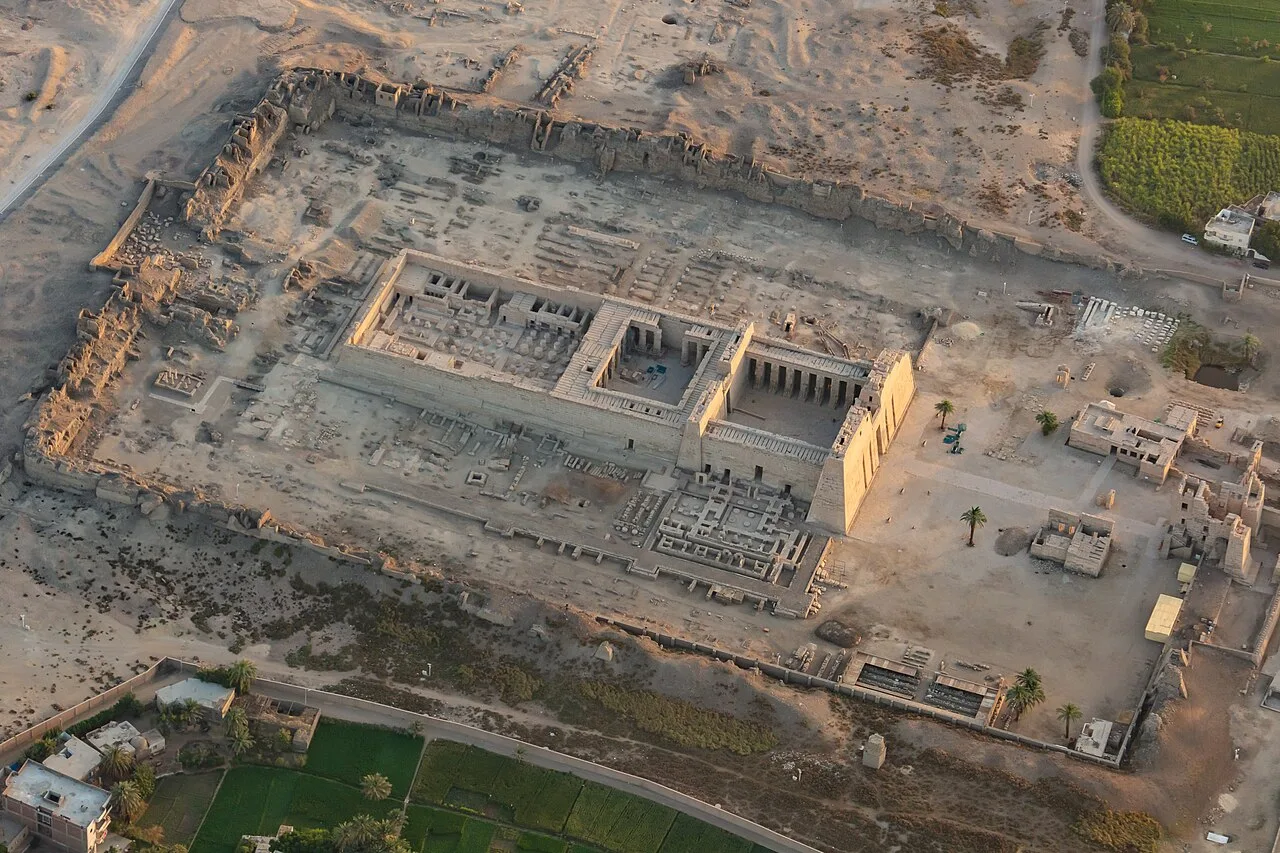
The mortuary temple of Ramesses III on Luxor's west bank.
Medinet Habu (Arabic: مدينة هابو, romanized: Madīnat Hābū; Ancient Egyptian: ḏ3mwt; Sahidic Coptic: (ⲧ)ϫⲏⲙⲉ, ⲉϫⲏⲙⲉ, ϫⲏⲙⲏ, ϫⲉⲙⲉ, ϫⲉⲙⲏ, ϫⲏⲙⲓ; Bohairic Coptic: ϭⲏⲙⲓ) is an archaeological locality situated near the foot of the Theban Hills on the West Bank of the River Nile opposite the modern city of Luxor, Egypt. Although other structures are located within the area and important discoveries have also been made at these sites, the location is today associated almost synonymously with the largest and best preserved site, the Mortuary Temple of Ramesses III. It was an important New Kingdom period temple structure in the West Bank of Luxor in Egypt. Aside from its size and architectural and artistic importance, the mortuary temple is probably best known as the source of inscribed reliefs depicting the advent and defeat of the "sea peoples" during the reign of Ramesses III (c. 1186–1155 BC), including the Battle of the Delta. Some of the building
materials were re-used from earlier monuments including the destroyed mortuary temple of Tausret (c. 1191–1189 BC) the last known ruler and the final pharaoh of the Nineteenth Dynasty of Egypt. The Greco-Roman period temple to Isis, Deir el-Shelwit, lies
4 kilometers to the south and re-used inscribed blocks from Medinet Habu were found there.
The site of these temples included an inhabited human settlement since pharaonic times, which continued until the 9th century, by which time it was a Coptic center called Jeme. The last remnants of the former town were cleared during the excavations at the end of the 19th century.
Located adjacent to Medinet Habu, north of the outer wall, lies the poorly preserved memorial Temple of Ay (c. 1323–1319 BC) and Horemheb (c. 1300 BC). The temple was originally built by Ay and later usurped by Horemheb who removed all inscriptions and images of Ay. A large Quartzite statue of a Pharaoh that was usurped to represent Horemheb was excavated from the ruins of the Ay and Horemheb temple in the 1930s, and is now on display in the Institute for the Study of Ancient Cultures (ISAC). Traces of previous cartouches on the statue confirm that the statue was originally of Tutankhamun, which was overwritten by cartouches of Ay and later Horemheb when the later pharaohs repurposed the statue for the temple.
Just to the northwest of Medinet Habu the Oriental Institute of Chicago, now called ISAC, excavated a large late Roman period cemetery. Most of the graves had been plundered but a number of artifacts, including 66 mummy tags inscribed in Greek were recovered.
Information source: Wikipedia · rewritten and edited by Maalem; available under CC BY-SA 4.0
- Built / established
- 12th century BC
- Location
- Luxor, Egypt
- Coordinates
- 25.7197, 32.6008
- Category
- Ancient Sites
Key facts
- Its reliefs depict Ramesses III's defeat of the Sea Peoples.
Source: Wikipedia · Factual information about the real landmark; unrelated to virtual ownership.
Price & ownership history
Landmarks near Medinet Habu
Map → Available
📖 8 K reads
Available
📖 8 K reads
 Available
📖 12 K reads
Available
📖 12 K reads
 Available
📖 13 K reads
Available
📖 13 K reads
 Available
📖 33 K reads
Available
📖 33 K reads