Red Pyramid
Virtual asset linked to this landmark

- Virtual owner
- The platform
- Times sold
- 0
- Fame on Wikipedia
- 92,494 article reads in 12 months
- Searches (30 days)
- 0
- Watching
- 0
Virtual ownership only. It gives no legal, financial or physical right in the real landmark. Prices are set by the market and may fall.
About Red Pyramid and its history
Egypt's third-largest pyramid, considered the first successful smooth-sided "true" pyramid.
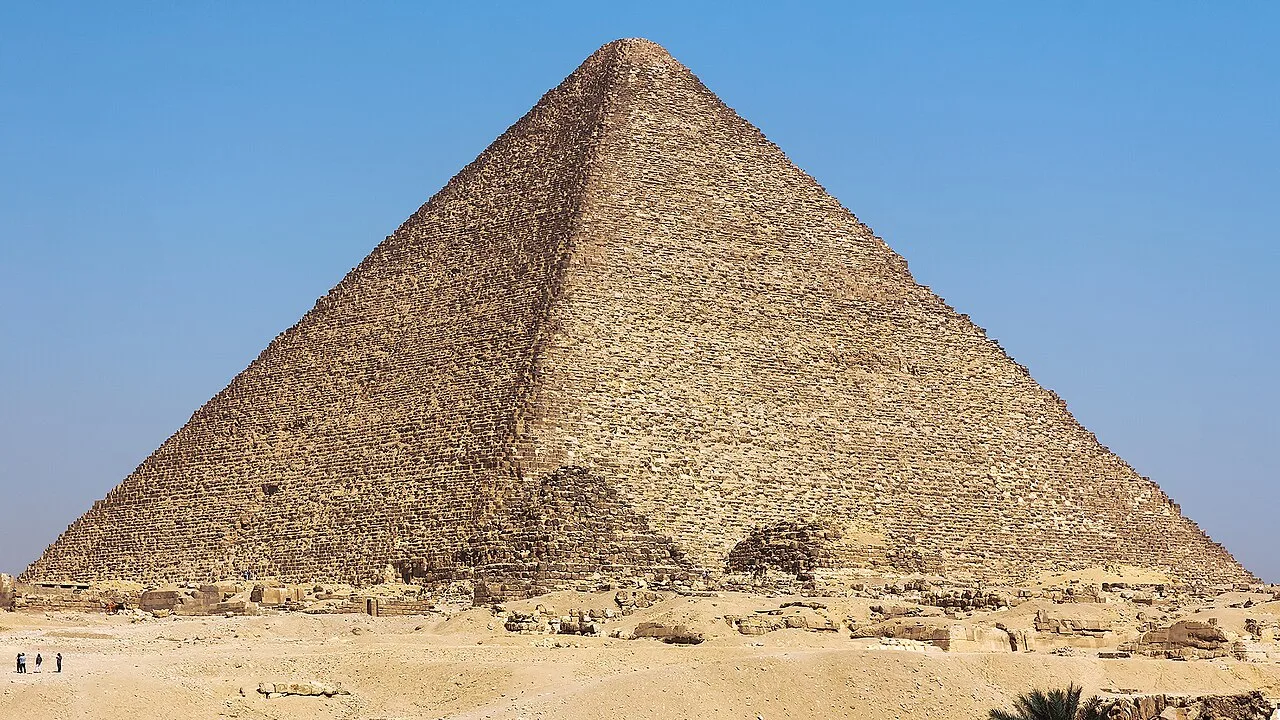
The Red Pyramid, also called the North Pyramid, is the largest of the pyramids located at the Dahshur necropolis in Cairo, Egypt. It is the third largest Egyptian pyramid, after those of Khufu and Khafre at Giza. It is believed to be Egypt's first successful attempt at constructing a "true" smooth-sided pyramid.
The pyramid is named for the rusty reddish hue of its limestone, but it was not originally red – it was clad in white Tura limestone. During the Middle Ages, much of the cladding was taken for buildings in Cairo, exposing the red limestone. Only a few white blocks remain, at the pyramid's base.
Local residents refer to the Red Pyramid as el-heram el-watwaat, meaning the Bat Pyramid.
History
The Red Pyramid was the third pyramid built by Old Kingdom Pharaoh Sneferu, and was built 2575–2563 BCE. The Red Pyramid is located approximately one kilometre (0.62 mi) to the north of the Bent Pyramid. It is built at the same shallow 43-degree angle as the upper section of the Bent Pyramid, which gives it a noticeably squat appearance compared to other Egyptian pyramids of comparable scale. Construction is believed to have begun during the thirtieth year of Sneferu's reign (c. 2590 BCE). Egyptologists disagree on the length of time it took to construct. Based on quarry marks found at various phases of construction, Rainer Stadelmann estimates the time of completion to be approximately 17 years while Rolf Krauss, based on this same graffiti, suggests a period of construction of 10–11 years, an estimate later supported by John Romer.
Archaeologists speculate its design may be an outcome of engineering crises experienced during the construction of Sneferu's two earlier pyramids. The first of these, the Pyramid at Meidum, collapsed in antiquity, while the second, the Bent Pyramid, had the angle of its inclination dramatically altered from 54 to 43 degrees part-way through the construction due to complications that accrued during the three construction phases.
Some archaeologists now believe that the Meidum pyramid was the first attempt at building a smooth-sided pyramid, and that it may have collapsed when construction of the Bent Pyramid was already well under way – and that the pyramid may by then have already begun to show alarming signs of instability itself, as evident by the presence of large timber beams supporting its inner chambers. The outcome of this was the change in inclination of the Bent Pyramid, and the commencement of the later Red Pyramid at an inclination known to be less susceptible to instability and therefore less susceptible to catastrophic collapse.
Information source: Wikipedia · rewritten and edited by Maalem; available under CC BY-SA 4.0
- Built / established
- c. 2590 BC (reign of Sneferu)
- Location
- Giza, Egypt
- Coordinates
- 29.8088, 31.2061
- Category
- Pyramids
Key facts
- Named after the reddish hue of its limestone.
Source: Wikipedia · Factual information about the real landmark; unrelated to virtual ownership.
Price & ownership history
Landmarks near Red Pyramid
Map → Available
📖 84 K reads
Available
📖 84 K reads
 Available
📖 23 K reads
Available
📖 23 K reads
 Available
📖 7 K reads
Available
📖 7 K reads
 Available
📖 9 K reads
Available
📖 9 K reads