Memphis Open-Air Museum
Virtual asset linked to this landmark

- Virtual owner
- The platform
- Times sold
- 0
- Fame on Wikipedia
- 306,559 article reads in 12 months
- Searches (30 days)
- 0
- Watching
- 0
Virtual ownership only. It gives no legal, financial or physical right in the real landmark. Prices are set by the market and may fall.
About Memphis Open-Air Museum and its history
An open-air museum on the site of the ancient capital Memphis, home to a colossal recumbent statue of Ramesses II.
Memphis (Egyptian Arabic: منف, romanized: Manf, pronounced [mænf]; Bohairic Coptic: ⲙⲉⲙϥⲓ; Greek: Μέμφις), or Men-nefer, was the ancient capital of Inebu-hedj, the first nome of Lower Egypt that was known as mḥw ("North"). Its ruins are located in the vicinity of the present-day village of Mit Rahina (Arabic: ميت رهينة), in Badrashin markaz (county), Giza Governorate, Egypt.
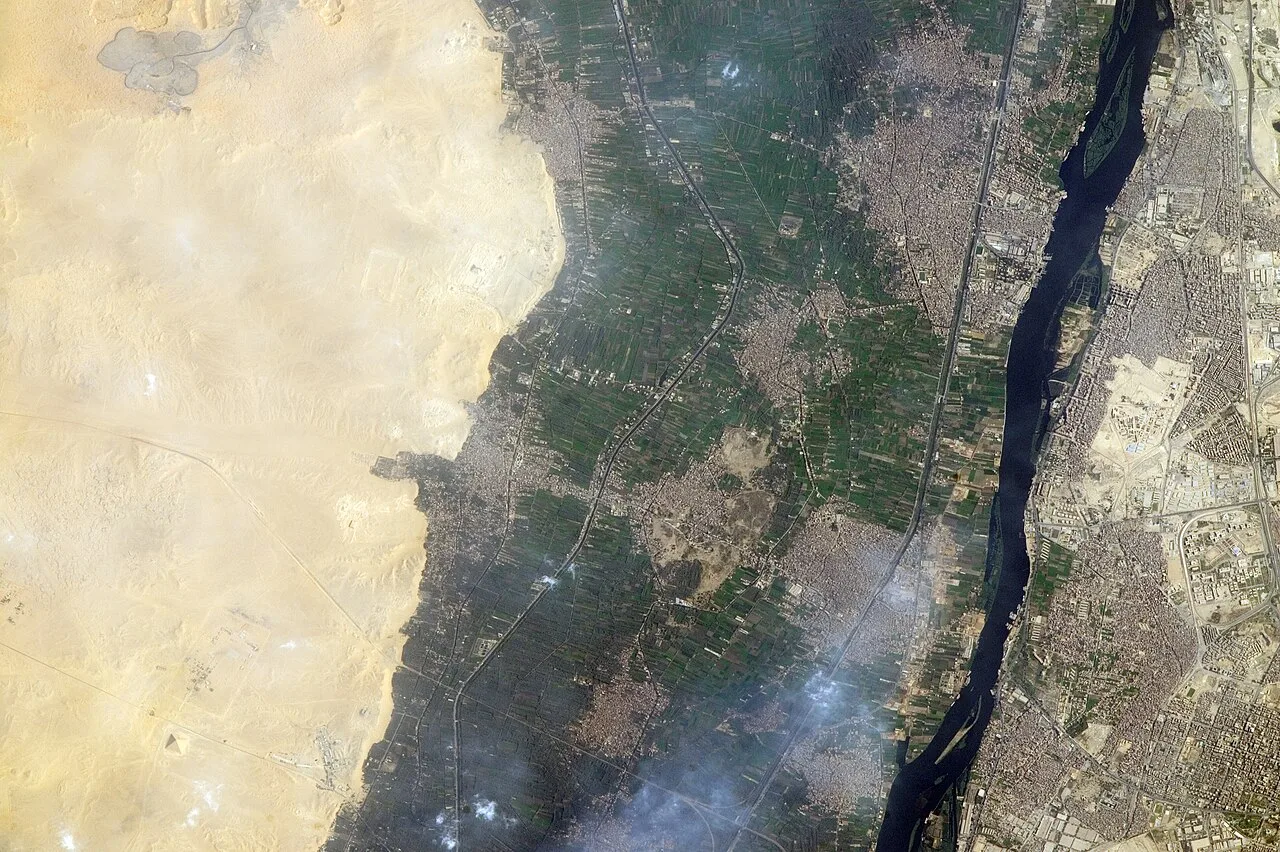
Along with the pyramid fields that stretch across a desert plateau for more than 30 kilometres (19 mi) on its west, including the famous Pyramids of Giza, Memphis and its necropolis have been listed as a World Heritage Site. The site is open to the public as an open-air museum.
According to legends related in the early third century BC by Manetho, a priest and historian who lived in the Ptolemaic Kingdom during the Hellenistic period of Egyptian history, the city was founded by King Menes. It was the capital of ancient Egypt (Kemet or Kumat) during both the Early Dynastic Period and Old Kingdom and remained an important city throughout ancient Egyptian history. It occupied a strategic position at the mouth of the Nile Delta, and was a hub of bustling activity. Its principal port, Peru-nefer (not to be confused with Peru-nefer at Avaris), featured a high density of workshops, factories, and warehouses that distributed food and merchandise throughout the ancient kingdom. During its golden age, Memphis thrived as a regional centre for commerce, trade, and religion.
Memphis was believed to be under the protection of the god Ptah, the patron of craftsmen. Its great temple, Hut-ka-Ptah (meaning "Enclosure of the ka of Ptah"), was one of the most prominent structures in the city. The name of this temple, rendered in Greek as Aἴγυπτoς (Ai-gy-ptos) by Manetho, is believed to be the etymological origin of the modern English name Egypt.
The history of Memphis is closely linked to that of the region itself. Its eventual downfall is believed to have been due to the loss of its economic significance in late antiquity, following the rise of coastal Alexandria. Its religious significance was diminished after the abandonment of the ancient religion following the Edict of Thessalonica (380 AD), which made Nicene Christianity the sole religion of the Roman Empire. By the Middle Ages, nearby Cairo had emerged as a major political and economic center.
Today, the ruins of the former capital offer fragmented evidence of its past. Many of its remains have become significant tourist destinations.
Information source: Wikipedia · rewritten and edited by Maalem; available under CC BY-SA 4.0
- Location
- Giza, Egypt
- Coordinates
- 29.8490, 31.2550
- Category
- Museums
Source: Wikipedia · Factual information about the real landmark; unrelated to virtual ownership.
Price & ownership history
Landmarks near Memphis Open-Air Museum
Map → Available
📖 9 K reads
Available
📖 9 K reads
 Available
📖 4 K reads
Available
📖 4 K reads
 Available
📖 7 K reads
Available
📖 7 K reads
 Available
📖 9 K reads
Available
📖 9 K reads