Babylon Fortress
Virtual asset linked to this landmark

- Virtual owner
- The platform
- Times sold
- 0
- Fame on Wikipedia
- 30,585 article reads in 12 months
- Searches (30 days)
- 0
- Watching
- 0
Virtual ownership only. It gives no legal, financial or physical right in the real landmark. Prices are set by the market and may fall.
About Babylon Fortress and its history
An ancient Roman fortress in the Old Cairo district.
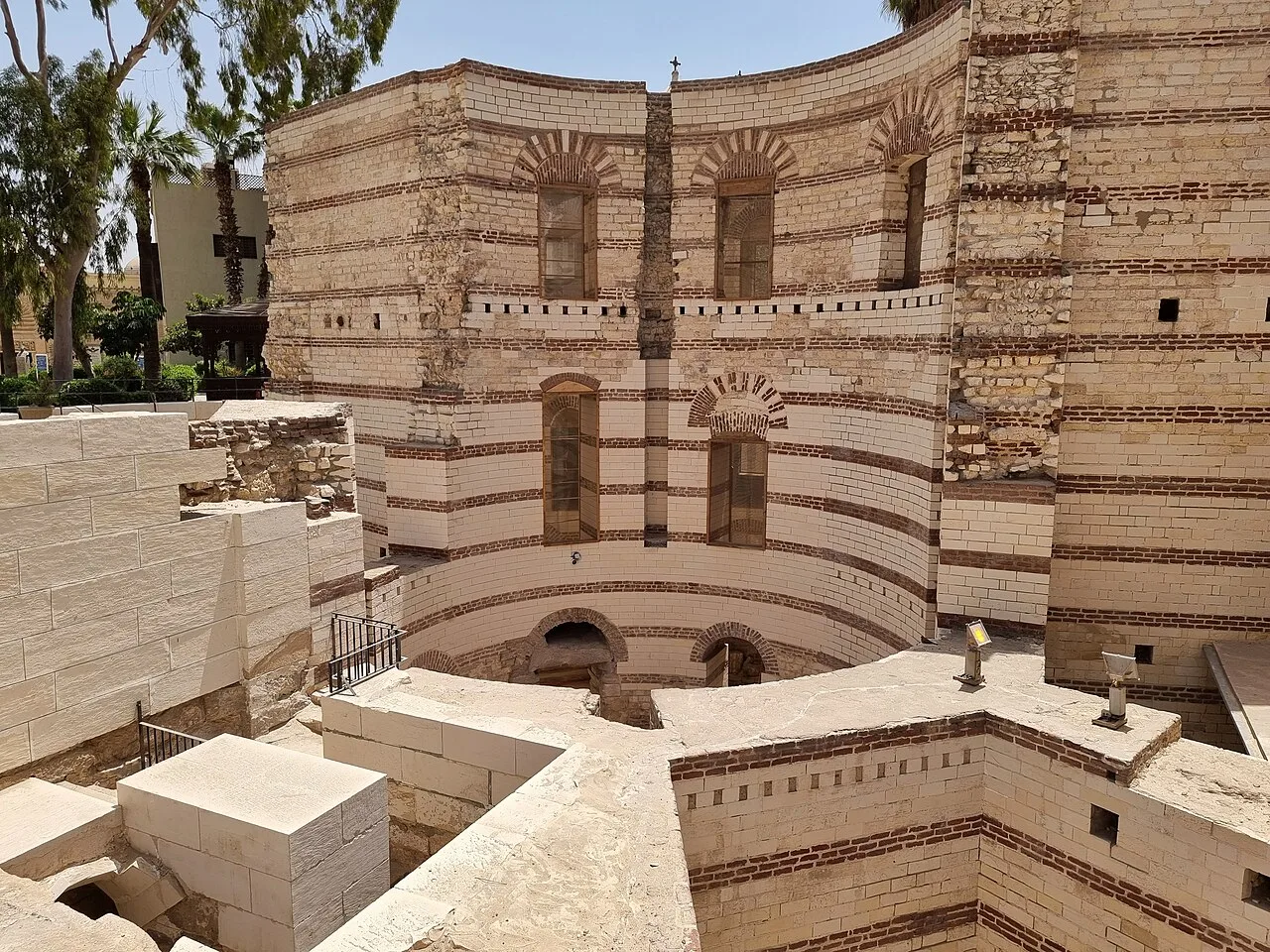
Babylon Fortress (Arabic: حصن بابليون; Coptic: ⲡⲁⲃⲓⲗⲱⲛ or Ⲃⲁⲃⲩⲗⲱⲛ) is an ancient Roman fortress on the eastern bank of the Nile Delta, located in the area known today as Old Cairo or Coptic Cairo. The fortress was built circa 300 AD by Emperor Diocletian in order to protect the entrance to an ancient canal, previously rebuilt by Trajan, that linked the Nile with the Red Sea.
It was at the boundary between Lower and Middle Egypt, where the river craft paid tolls when ascending or descending the Nile. Within the fortress's former enclosure are the present-day Coptic Museum, a convent, and several churches, including the Church of St. George and the Hanging Church.
Name
According to the 7th-century writer John of Nikiu, the name "Babylon" was given by Nebuchadnezzar II, the second king of the Neo-Babylonian Empire, who conquered or campaigned in the area circa 568 BC. He named it after his own home city, Babylon, which was the dominant city of Mesopotamia. According to Egyptologists, the ancient name of the site was Kheriaha, although Spiegelberg derives the modern Babylon name from Perhabinon.
Situation
Babylon lay northeast of Memphis, on the east bank of the Nile, and near the commencement of the Canal of the Pharaohs connecting the Nile to the Red Sea. It was the boundary town between Lower and Middle Egypt, where the river craft paid tolls when ascending or descending the Nile.
History
Some historical sources, such as John of Nikiu, report that a fortress named Babylon was first founded by Nebuchadnezzar II circa 568 BC, at the site where an ancient Egyptian canal linked the Nile with the Red Sea. During an uprising, Babylonian prisoners established a stronghold between Memphis and Heliopolis, on an elevation on the east bank of the Nile. The canal was re-dug by the Persian king Darius (r. 521–486 BC).
The fortress's origins are often associated with Trajan (r. 98–117), who created the Amnis Traianus, a reconstruction of the Red Sea canal that had fallen out of use. Trajan reportedly moved the mouth of the canal further south from its former location, to the site of what is now Old Cairo, where he also constructed a fortified harbor. The construction of the present Babylon Fortress (whose remains are visible today) has been attributed by more recent archeological research to the reign of Diocletian (r. 285–305), who expanded the fortifications at the mouth of the canal around 300 AD. The large new fortress, probably made necessary after the Crisis of the Third Century, provided a considerable defense for both the land and sea routes in the region. The canal passed between two massive round towers and ran through the middle of the fortress. In later centuries, a wall was built between the two large towers to block the canal.
The town was the seat of a Christian bishopric, a suffragan of Leontopolis, the capital and metropolitan see of the Roman province of Augustamnica Secunda. The names of several of its bishops are recorded.
Information source: Wikipedia · rewritten and edited by Maalem; available under CC BY-SA 4.0
- Built / established
- Roman era
- Location
- Cairo, Egypt
- Coordinates
- 30.0059, 31.2302
- Category
- Historic Landmarks
Source: Wikipedia · Factual information about the real landmark; unrelated to virtual ownership.
Price & ownership history
Landmarks near Babylon Fortress
Map → Available
📖 33 K reads
Available
📖 33 K reads
 Available
📖 2 K reads
Available
📖 2 K reads
 Available
📖 2 K reads
Available
📖 2 K reads
 Available
📖 6 K reads
Available
📖 6 K reads