Dumat al-Jandal
Virtual asset linked to this landmark

- Virtual owner
- The platform
- Times sold
- 0
- Fame on Wikipedia
- 23,490 article reads in 12 months
- Searches (30 days)
- 0
- Watching
- 0
Virtual ownership only. It gives no legal, financial or physical right in the real landmark. Prices are set by the market and may fall.
About Dumat al-Jandal and its history
An ancient city in Al-Jouf at a crossroads of caravan routes, mentioned in Assyrian texts from the 8th century BC.
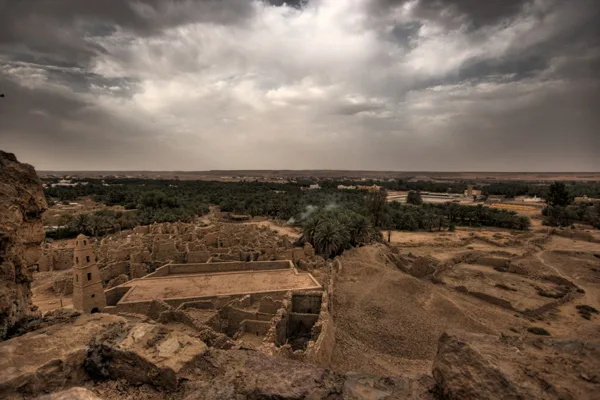
Dumat al-Jandal (Arabic: دُومَة ٱلْجَنْدَل, romanized: Dūmat al-Jandal, lit. 'Dumah of the Stone', pronounced [ˈduːmat alˈdʒandal]), also known as Al-Jawf or Al-Jouf (Arabic: ٱلْجَوْف, lit. 'cavity/depression'), which refers to Wadi Sirhan, is an ancient city of ruins and the historical capital of the region that is now al-Jouf Province in northwestern Saudi Arabia. It is located 37 kilometres (23 mi) from Sakaka.
The city stood north of the Nafud desert and at one end of Wadi Sirhan, at a major intersection of ancient trade routes part of what is known as the incense trade route, with one branch linking the various sources of valuable goods in India and South Arabia with Lower Mesopotamia, and another linking the Persian Gulf through Wadi Sirhan with southern Syria. It is surrounded by the historical Dumat al-Jandal Wall and stands within an oasis.
Some scholars identify this site as territory of Dumah, one of the twelve sons of Ishmael mentioned in the Book of Genesis.
Etymology
The name Dumat al-Jandal means literally "Dumah of the Stone"; the name Al-Jawf means "depression", referring to Wadi Sirhan. The city's ancient Akkadian name was Adummatu, as attested on the Esarhaddon Prism (673–672 BC), where it is described as "the strong city of the Arabians."
In 2020, archaeologists reported discovering a 35-meter long triangular megalithic stone platform surrounded by burials and dating back to the 6th millennium BCE, presumably dedicated to ritual practices. Archaeological researchers from France, Saudi Arabia and Italy, headed by Olivia Munoz, believe that these findings illuminate a pastoralist nomadic lifestyle and a ritual used in prehistoric Arabia.
The city has a history dating back to the 10th century BC and is mentioned in Akkadian inscriptions of the Neo-Assyrian Empire dating to 845 BCE, in which it is referred to as Adummatu and is described as the capital of an Arab kingdom sometimes named as Qedar (Qidri). The names of five powerful Arab queens that ruled this city are known, among them Zabibe, Šamši, Tabūʿa, and Teʾelḫunu. The latter is also given the title of high priestess of Atarsamain, a deity of fertility, love and war associated with Ishtar. Dūmah was the site of an important temple dedicated to Ishtar. The ancient city of Duma was described as "the stronghold of the Arabians" on the Neo-Assyrian Esarhaddon Prism (cuneiforms on clay prism, 673-672 BC).
This town is perhaps intended in a passage from Isaiah:
The "Dumah" Pronouncement.
A call comes to me from Seir:
"Watchman, what of the night?
Watchman, what of the night?"
The watchman replied,
"Morning came, and so did night.
If you would inquire, inquire.
Come back again."
Sacrifices of animals were common and Porphyry's De Abstenentia (3rd century AD) reports that in Dūmah, a boy was sacrificed annually and was buried underneath an altar. Some scholars have extrapolated this practice to the rest of the Nabataeans.
Information source: Wikipedia · rewritten and edited by Maalem; available under CC BY-SA 4.0
- Location
- Al-Jouf, Saudi Arabia
- Coordinates
- 29.8114, 39.8683
- Category
- Ancient Sites
Source: Wikipedia · Factual information about the real landmark; unrelated to virtual ownership.
Price & ownership history
Landmarks near Dumat al-Jandal
Map → Available
📖 4 K reads
Available
📖 4 K reads
 Available
 Available
📖 23 K reads
Available
📖 23 K reads
 Available
📖 2 K reads
Available
📖 2 K reads