Buried Pyramid of Sekhemkhet
Virtual asset linked to this landmark

- Virtual owner
- The platform
- Times sold
- 0
- Fame on Wikipedia
- 17,054 article reads in 12 months
- Searches (30 days)
- 0
- Watching
- 0
Virtual ownership only. It gives no legal, financial or physical right in the real landmark. Prices are set by the market and may fall.
About Buried Pyramid of Sekhemkhet and its history
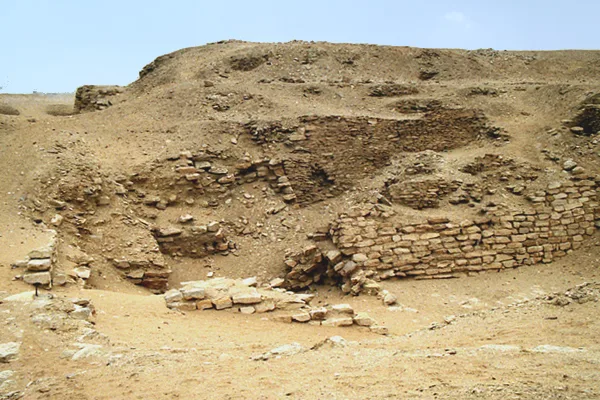
An unfinished step pyramid of the Third Dynasty king Sekhemkhet at Saqqara, discovered by Zakaria Goneim in 1951.
The Step Pyramid of Sekhemkhet (Buried Pyramid) is an unfinished seven-step pyramid constructed c. 2645 BC for Sekhemkhet. He was the second king of the Third Dynasty of Ancient Egypt, which reigned over Egypt c. 2686–2613 BC and is usually placed at the beginning of the Old Kingdom of Egypt. Many historians believe that the third dynasty played an important role in the transition from Early Dynastic Period of Egypt to the Age of the Pyramids.
The pyramid may be visited, but the public is not allowed access to the base and substructures.
Sekhemkhet Djoserty was also the successor to the better-known pharaoh Netjerikhet Djoser, who was buried in his famous step pyramid at Saqqara. The buried pyramid was originally modelled after Djoser's step pyramid and is located several hundred metres southwest. It is also arguable that the pyramid of Sekhemkhet was originally designed to surpass the step pyramid of Djoser but barely made it above ground level and hence was given the name the Buried Pyramid. Its incompletion is thought to have been due to Sekhemkhet's short reign as ruler, which was approximately six years.
History
The Buried Pyramid was a previously unknown structure until, in 1951, Egyptologist Zakaria Goneim noticed the odd rectangular shape in the desert while excavating the nearby Unas complex. A three part rubble-coursed enclosure wall was first discovered, and by digging to its bottom, it was found to be 5.2 m (17 ft) tall and 18 m (60 ft) thick. He later discovered that the wall further extended on both sides to dimensions of 520 m (1,700 ft) in the north–south axis and 180 m (600 ft) to the east–west and was full of false doors and niches.
The pyramid itself was located at the centre of the complex, with a base length of 115 m (377 ft), it had only one step and was unfinished. As a result, Goneim initially thought that it was a mastaba. During the next stage of excavation, Goneim discovered a descending passage to the north side which led to a gallery blocked with rubble and masonry, convincing him that it was actually a pyramid. Objects found during the excavation of this gallery included animal bones, demotic papyri, and Third Dynasty stone vessels. In a decayed wooden casket, gold was discovered which included gold bracelets, cosmetic cases, beads, and jars inscribed with Sekhemkhet's name.
When the blocked wall was breached, on May 31, 1954, an unfinished and undecorated burial chamber was discovered. Inside it, lay an alabaster sarcophagus cut from a single block with a vertical lid which seemed to still be sealed. On June 26, 1954, after great difficulties to unblock and raise the lid, the sarcophagus was opened and was found to be empty.
Harsh criticism of Goneim which wrongfully spread the rumor that he had supposedly helped in the smuggling of an ancient artifact out of Egypt and his subsequent suicide (or murder) on January 12, 1959, dampened the interest in the pyramid and its investigation was left incomplete.
Information source: Wikipedia · rewritten and edited by Maalem; available under CC BY-SA 4.0
- Location
- Giza, Egypt
- Coordinates
- 29.8664, 31.2131
- Category
- Pyramids
Source: Wikipedia · Factual information about the real landmark; unrelated to virtual ownership.
Price & ownership history
Landmarks near Buried Pyramid of Sekhemkhet
Map → Available
📖 24 K reads
Available
📖 24 K reads
 Available
📖 177 K reads
Available
📖 177 K reads
 Available
📖 61 K reads
Available
📖 61 K reads
 Available
📖 9 K reads
Available
📖 9 K reads