Pompey's Pillar
Virtual asset linked to this landmark

- Virtual owner
- The platform
- Times sold
- 0
- Fame on Wikipedia
- 10,890 article reads in 12 months
- Searches (30 days)
- 0
- Watching
- 0
Virtual ownership only. It gives no legal, financial or physical right in the real landmark. Prices are set by the market and may fall.
About Pompey's Pillar and its history
A Roman triumphal column of red granite erected in honour of the emperor Diocletian.
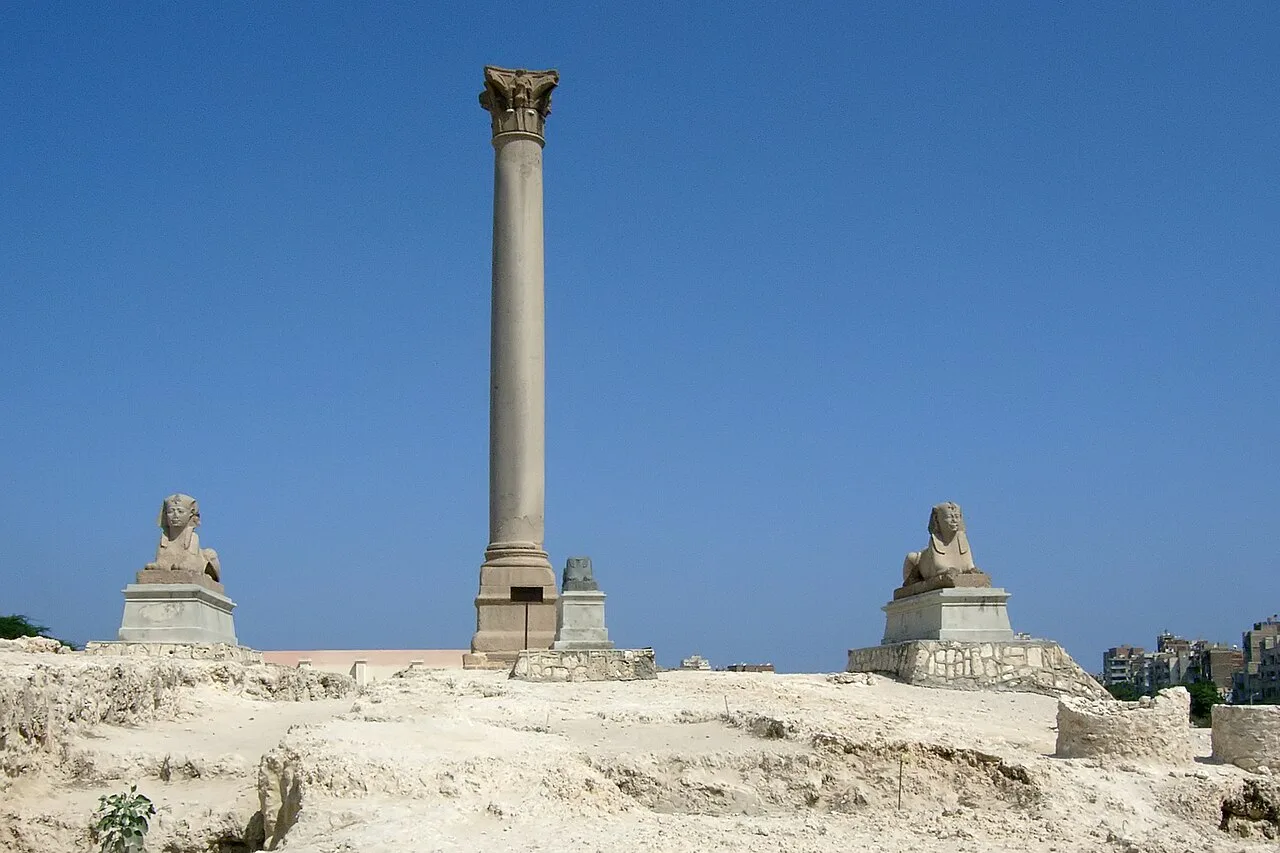
Pompey's Pillar (Arabic: عمود السواري, romanized: 'Amud El-Sawari) is a Roman triumphal column in Alexandria, Egypt. Despite its modern name, it was actually set up in honour of the Roman emperor Diocletian between 298–302 AD. The giant Corinthian column originally supported a colossal porphyry statue of the emperor in armour. It stands at the eastern side of the temenos of the Serapeum of Alexandria, which is now in ruins.
It is the only ancient monument in Alexandria that is still standing in its original location.
Name
The local name is Arabic: عمود السواري, romanized: 'Amud El-Sawari, where the word 'Amud means "column". The name Sawari has been translated in many ways by scholars, including Severus (i.e. Emperor Septimius Severus).
The name of Pompey in relation to the pillar was used by many European writers in early modern times. The name is considered to stem from a historical misreading of the Greek dedicatory inscription on the base; the name ΠΟΥΠΛΙΟΣ (Πού̣π̣[λιος], Pouplios) was confused with ΠΟΜΠΗΙΟΣ (Ancient Greek: Πομπήιος, romanized: Pompeios).
Construction
In 297 Diocletian, Augustus since 284, campaigned in Egypt to suppress the revolt of the usurper Domitius Domitianus. After a long siege, Diocletian captured Alexandria and executed Domitianus's successor Aurelius Achilleus in 298. In 302 the emperor returned to the city and inaugurated a state grain supply. The dedication of the column monument and its statue of Diocletian, describes Diocletian as polioúchos (Ancient Greek: πολιοῦχον Ἀλεξανδρείας, romanized: polioúchon Alexandreias, lit. 'city-guardian-god ACC of Alexandria'). In the fourth century AD this designation also applied to Serapis, the male counterpart of Isis in the pantheon instituted by the Hellenistic rulers of Egypt, the Ptolemies. The sanctuary complex dedicated to Serapis in which the column was originally erected, the Serapeum, was built under King Ptolemy III Euergetes in the third century BC and rebuilt under Roman rule, likely in the late 2nd to early 3rd century CE, being completed under Emperor Caracalla. In the later fourth century AD it was considered by Ammianus Marcellinus a marvel rivalled only by Rome's sanctuary to Jupiter Optimus Maximus on the Capitoline Hill, the Capitolium.
The monument stands some 26.85 m (88.1 ft) high, including its base and capital, and originally would have supported a statue some 7 m (23 ft) tall. The only known monolithic column in Roman Egypt (i.e., not composed of drums), it is one of the largest ancient monoliths and one of the largest monolithic columns ever erected. The monolithic column shaft is 20.46 m (67.1 ft) in height with a diameter of 2.71 m (8 ft 11 in) at its base, and the socle itself is over 6 m (20 ft) tall. Both are of lapis syenites, a pink granite cut from the ancient quarries at Syene (modern Aswan), while the column capital of pseudo-Corinthian type is of grey granite.
Information source: Wikipedia · rewritten and edited by Maalem; available under CC BY-SA 4.0
- Built / established
- c. 300 AD
- Location
- Alexandria, Egypt
- Coordinates
- 31.1825, 29.8964
- Category
- Ancient Sites
Key facts
- It stands about 27 m high including its base.
Source: Wikipedia · Factual information about the real landmark; unrelated to virtual ownership.
Price & ownership history
Landmarks near Pompey's Pillar
Map → Available
📖 50 K reads
Available
📖 50 K reads
 Available
📖 7 K reads
Available
📖 7 K reads
 Available
 Available